A wallet is not a place where your coins live. The coins live on the blockchain. A wallet is the set of keys that prove the coins are yours. Lose the keys, lose the coins. Hand the keys to someone else, hand them the coins.
Last month, we told you to move your crypto off the exchange. Here is how you actually do it.
A wallet is not a place where your coins live. The coins live on the blockchain. A wallet is the set of keys that prove the coins are yours. Lose the keys, lose the coins. Hand the keys to someone else, hand them the coins.
That is the whole concept. Everything else is detail.
The Address and the Key
Every wallet gives you two things. The first is a public address, a long string of letters and numbers you give to anyone who wants to send you crypto. Share it freely. It works like an email address.
The second is a private key, usually shown to you as a sequence of twelve or twenty-four words called a seed phrase. This is the master key to everything you own.
Write it on paper. Better still, stamp it into a steel backup plate, which survives fire and flood. Store it somewhere only you know. Never photograph it, never type it into a website, never save it to cloud storage, never read it aloud to anyone for any reason.
Warning: If a support agent asks for your seed phrase, they are stealing from you. If a website asks you to verify your wallet by entering it, the site is a scam. There are no exceptions to this.
Hot Wallets and Cold Wallets
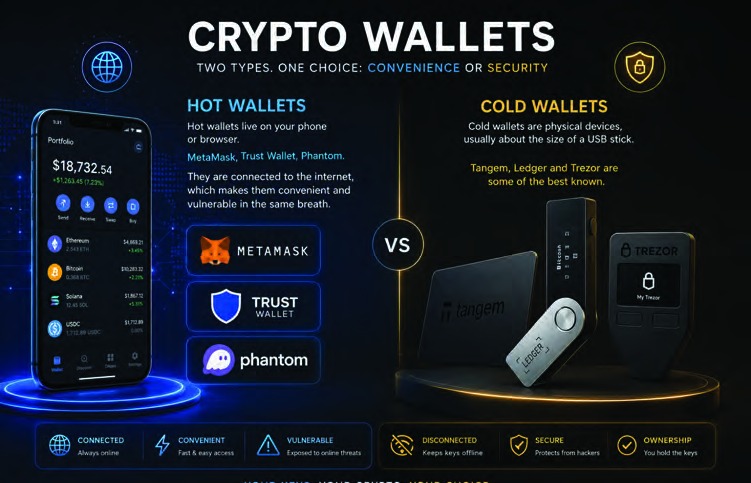
Hot wallets live on your phone or browser. MetaMask, Trust Wallet, Phantom. They are connected to the internet, which makes them convenient and vulnerable in the same breath. Use them for small amounts you intend to move or spend.
Cold wallets are physical devices, usually about the size of a USB stick or credit card. Tangem, Ledger, and Trezor are some of the best known. Tangem is Crypto Magazine's preferred provider. They keep your private key offline, signing transactions only when you physically press a button or tap the NFC chip. Use them for the savings you do not plan to touch.
A simple rule: Hot for spending, cold for keeping.
▲ article_3_stablecoins_flow
Networks Matter
Here is the mistake that loses beginners more money than any other. Bitcoin lives on the Bitcoin network. Ethereum and most tokens you have heard of live on the Ethereum network. Tokens on Binance Smart Chain live on BSC. Solana tokens live on Solana. They cannot be sent between these networks without a special tool called a bridge.
When you send crypto, both the sending side and the receiving side must agree on the network. If you send USDT on the Tron network to a wallet that only supports USDT on Ethereum, your funds disappear into the gap and are not coming back.
Your First Send
Every transaction pays a small fee to the network that processes it. On Bitcoin and Ethereum it can be a few pounds when the network is busy. On Solana or Polygon it is pennies. The fee is taken from the sending wallet on top of the amount you send, so always leave a little extra behind.
Now the actual send:
Copy the receive address from the wallet you are sending to.
Paste it into the sending wallet.
Confirm the network matches on both sides.
Send the smallest amount the platform will allow (a pound or a dollar test amount).
Wait for the test amount to arrive and check the receiving wallet balance.
Only then send the rest.
This habit costs a few pence in fees and protects everything you own.
You Now Own Crypto Properly
Your coins are no longer the exchange's coins held under your name. They are yours, secured by a phrase that exists in one place in the world, written on paper or steel, known to you alone. The platform can disappear tomorrow and your crypto remains.
This is what crypto actually offers: not just the chance to build wealth, but the chance to own something that cannot be taken from you by a third party. Next month, we look at the buttons on a chart and what they actually do.
Annual Pass
Annual Subscriptions & Full Access
Enjoyed Issue 14? Get Heavyweight Print Delivered.
You just read a complimentary long-form feature from CryptoMagazine Issue 14. Every print edition features exclusive deep-dives, market data, and institutional perspectives crafted to be kept. Subscribe annually to receive every print edition delivered to your door.